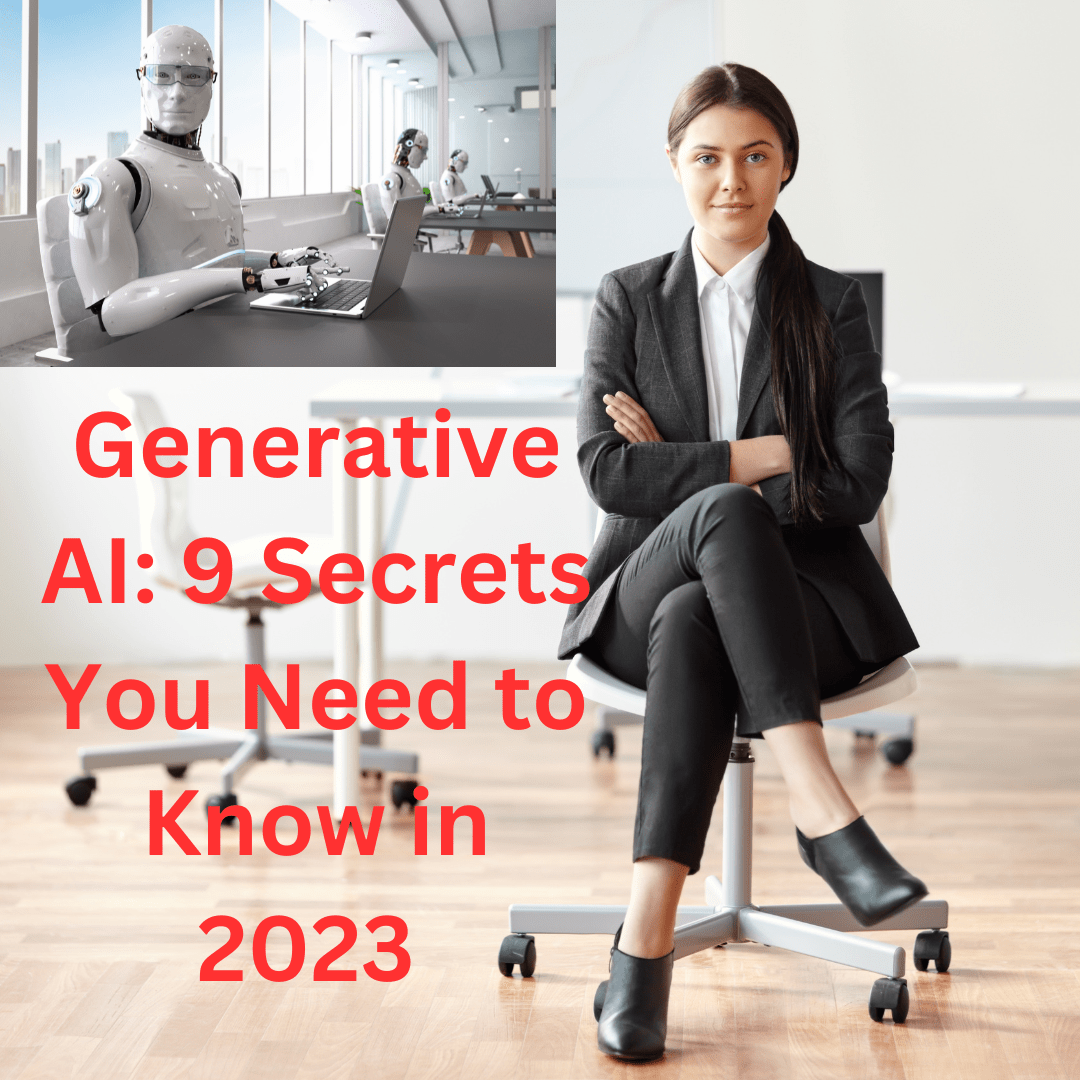
Artificial Intelligence (AI) has been a buzzword for several years, but Generative AI is still a relatively new field that is rapidly growing and evolving.
Generative AI allows machines to generate new content, whether that be images, text, or even music. It has already made a significant impact in a wide range of industries, from healthcare and finance to marketing and creative production.
As we look ahead to 2023, it is clear that Generative AI will continue to be a key player in shaping the future of technology and innovation.

Here are some secrets you need to know about Generative AI in 2023, including its current impact and future potential, ethical implications, common challenges, recent developments, and the skills and tools required for success in this exciting field.
Generative AI: 9 Secrets You Need to Know in 2023
- The Growth of Generative AI: A Brief Introduction
What is Generative AI?
Generative AI is a type of machine learning that involves creating new data based on existing data, rather than just predicting or classifying it. In other words, generative AI algorithms are designed to create new outputs that resemble real data to learn and improve.
History of Generative AI
The history of generative AI dates back to the early days of artificial intelligence, with early research focusing on rule-based systems and expert systems.

However, generative AI, as we know it today, was made possible by advancements in neural networks and deep learning. This technology has enabled the creation of generative models that are capable of creating new data that is indistinguishable from real-world data.
- How Generative AI is Revolutionizing Industries
Impact of Generative AI on Healthcare
Generative AI is revolutionizing healthcare by enabling the creation of personalized treatment plans and improving the accuracy of medical diagnoses. Generative models can analyze large amounts of medical data to identify patterns and generate new insights, improving patient outcomes while reducing costs.
Applications of Generative AI in Finance
In the finance industry, generative AI is being used to analyze market trends, identify patterns, and create predictive models. This technology is enabling financial institutions to make better-informed decisions and improve their risk management strategies.

Generative AI in the Creative Industries
Generative AI is also being used in the creative industries to create new forms of art and music. These algorithms can generate entirely new compositions and visual designs, providing artists and designers with new creative possibilities.
- Understanding the Ethical Implications of Generative AI
The Importance of Responsible AI Development
As with all forms of AI, it’s important to prioritize responsible development and ensure that generative models are not biased or discriminatory. Developers must also consider the potential impact of generative AI on the workforce and work to create solutions that benefit everyone.

Privacy and Security Concerns with Generative AI
Generative AI algorithms require significant amounts of data to learn and create, which can raise privacy and security concerns. Developers need to prioritize data privacy and security in the development process and ensure that personal information is protected.
- Common Challenges Faced by Generative AI and How to Overcome Them
Data Quality and Quantity
One of the biggest challenges in generative AI is ensuring that the data used to train models is of sufficient quality and quantity to generate accurate outputs. To overcome this, developers can use techniques such as data augmentation and transfer learning, which can help to improve the quality of the data used to train models.

Overfitting and Underfitting
Generative AI models can also suffer from overfitting or underfitting, where they can either memorize the training data too well or fail to learn from it at all. To overcome this, developers can use techniques such as dropout and early stopping to improve the performance of their models.
Exploding and Vanishing Gradients
Finally, generative AI models can also suffer from exploding or vanishing gradients, which can make it difficult for them to learn and generate accurate outputs. To overcome this, developers can use techniques such as gradient clipping and normalization to ensure that the gradients remain within a reasonable range.

- The Future of Generative AI: Predictions and Forecasts
Generative AI is rapidly growing and evolving, and there are plenty of exciting predictions and forecasts for its future. Here are some emerging trends and forecasts for generative AI in 2023 and beyond:
Emerging Trends in Generative AI
One of the emerging trends in generative AI is the development of more sophisticated models that can generate high-quality images, videos, and audio with greater realism.
Another trend is the integration of generative AI with other advanced technologies, such as augmented reality and blockchain.

Forecasts for Generative AI in 2023 and Beyond
Experts predict that generative AI will continue to revolutionize various industries, including healthcare, finance, and entertainment. By 2023, generative AI models are expected to be sophisticated enough to create realistic 3D virtual environments and even entire films.
- Practical Applications of Generative AI in Business and Everyday Life
Generative AI has numerous practical applications in various fields. Here are some examples of how generative AI is being used in marketing, advertising, education, and gaming:

Generative AI in Marketing and Advertising
Generative AI is used in marketing and advertising to create highly personalized content for customers. For example, generative AI can generate unique product descriptions, blog posts, and social media posts, based on customer behavior and preferences.
Generative AI in Education
Generative AI is being used in education to create interactive learning experiences. For instance, generative AI can be used to create chatbots that can answer student questions and provide feedback on assignments.
Generative AI in Gaming
Generative AI is being used in gaming to create realistic virtual characters, environments, and objects. For example, generative AI can be used to create game scenarios and narratives, which players can explore and manipulate.

- Recent Developments in Generative AI Research
Generative AI research is continuously evolving, and researchers are developing new techniques and tools to improve the quality of generative AI models. Here are some recent developments in generative AI research:
New Techniques in Generative Adversarial Networks (GANs)
GANs are a type of neural network that can create high-quality images, videos, and audio. Researchers are developing new techniques to improve the stability and efficiency of GANs, such as gradient penalties and spectral normalization.
Advancements in Natural Language Processing (NLP)
NLP is a subfield of artificial intelligence that deals with the interaction between computers and humans using natural language.

Generative AI models that use NLP can generate high-quality text, such as articles and stories. Recent advancements in NLP, such as transformer models and attention mechanisms, have improved the quality of generative AI models.
- Key Skills and Tools Required for Success in Generative AI
To succeed in generative AI, you need to have a solid foundation in programming, mathematics, and statistics. Here are some essential skills and tools you need to become proficient in generative AI:
Programming Languages Essential for Generative AI
Python is the most widely used programming language in generative AI. Other programming languages that are useful for generative AI include R, Java, and C++.

Software Tools for Developing Generative AI Models
There are various software tools available to develop and train generative AI models, such as TensorFlow, PyTorch, and Keras.
These tools provide a user-friendly interface for developing and testing models and advanced features for optimizing and improving model performance.
Generative AI is a fascinating and rapidly evolving field that has already impacted a wide range of industries and has significant potential for future development.

By understanding the secrets of Generative AI, you can prepare for the opportunities and challenges that lie ahead and be part of the future of this exciting field.
Whether you are a business leader, a researcher, or a marketer, Generative AI is a field worth exploring.
More Videos – https://www.tiktok.com/@marketing_money_now
Pro-Tip
How To Improve Your Social Media Marketing and SEO Strategy