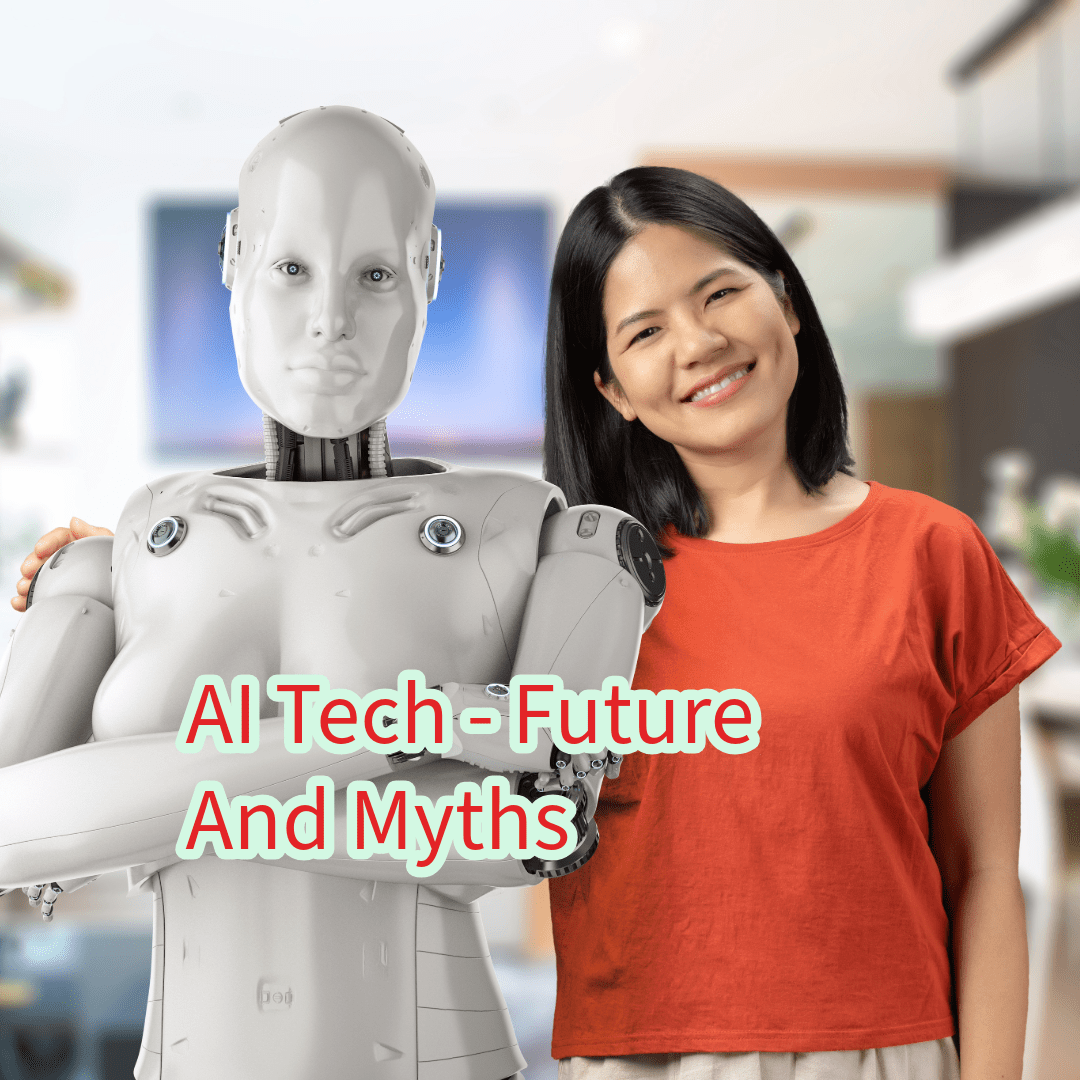
Artificial Intelligence (AI) is one of the most transformative forces of the 21st century, reshaping industries, economies, and daily life.
From autonomous vehicles to personalized healthcare, AI’s potential seems boundless, but there are some myths and misconceptions.
Discover the future of AI technology, its realistic applications, and the myths about it. Get a grounded perspective on where AI is headed and what it truly entails.
AI Tech – Future And Myths
The Future of AI
- AI in Healthcare: Precision and Accessibility
AI is revolutionizing healthcare by enabling precision medicine and improving accessibility. Machine learning models analyze vast datasets, genetic information, medical imaging, and patient histories, to predict diseases like cancer or Alzheimer’s earlier than traditional methods.

For instance, AI-powered diagnostic tools can detect diabetic retinopathy with accuracy rivaling human specialists (at a fraction of the cost).
In the future, AI will improve healthcare. Wearable devices integrated with AI will monitor vital signs in real time, alerting users to anomalies before they escalate.
Telemedicine platforms, enhanced by natural language processing (NLP), will provide personalized consultations in remote areas, bridging gaps in global healthcare access.
By 2030, AI could reduce diagnostic errors by 50% and save healthcare systems billions annually. (McKinsey report)
- Autonomous Systems: Beyond Self-Driving Cars
Autonomous vehicles are a popular AI tech market, with companies like Tesla and Waymo pushing boundaries. However, the future extends beyond cars.
AI-driven drones will optimize logistics, delivering goods to remote regions with minimal carbon footprints.

In agriculture, autonomous robots will plant, monitor, and harvest crops, increasing yields by up to 20% while reducing pesticide use.
Cities will also benefit. AI systems will manage traffic flows, reducing congestion and emissions in smart cities.
By 2040, autonomous systems could dominate transportation. The global market for autonomous vehicles is projected to reach $1.6 trillion.
- AI and Creativity: Redefining Art and Innovation
AI’s role in creativity is expanding, challenging the notion that it’s purely analytical. Tools like DALL·E and MidJourney generate art, music, and literature, but the future promises deeper collaboration.

AI will act as a creative partner, augmenting human imagination rather than replacing it.
In innovation, AI-driven simulations will accelerate scientific discovery. Quantum AI models could solve complex problems in material science or fusion energy, potentially unlocking sustainable energy sources by 2050.
This convergence of AI and human ingenuity will redefine industries and cultural expression.
- Ethical AI
AI affects society and ethical considerations are paramount. Future AI systems will prioritize fairness, transparency, and accountability. Governments and organizations are developing frameworks like the EU’s AI Act, which classifies AI applications by risk.

By 2030, global AI governance could standardize ethical practices, ensuring algorithms don’t perpetuate biases in hiring, criminal justice, or lending.
AI will be more explainable. Current “black box” models, where decision-making processes are opaque, will give way to interpretable AI, allowing users to understand and trust outputs.
This shift is critical for sectors like finance and healthcare.
- AI in Education: Personalized Learning
AI will change and improve education. Adaptive learning platforms will tailor curricula to individual student needs, adjusting pace and content based on real-time performance.
AI tutors, powered by NLP, will provide 24/7 support, making quality education accessible globally.

By 2035, AI could narrow educational disparities. Studies show a 30% improvement in learning outcomes for underserved communities.
However, challenges remain. Ensuring access to AI tools and preventing over-reliance on technology will be critical.
The future lies in balancing AI’s scalability with human mentorship.
AI Myths: Separating Fact from Fiction
AI is often misunderstood, fueled by science fiction and sensationalism.
Myth 1: AI Will Take Over the World
The fear of AI becoming sentient and dominating humanity, popularized by films like The Terminator, is unfounded. AI systems, including advanced models like Grok 3 or Chat GPT are tools designed for specific tasks.

They lack consciousness, emotions, or self-awareness. Even the most sophisticated AI operates within predefined parameters, guided by human inputs and objectives.
The real risk isn’t world domination but unethical applications or biased algorithms. Mitigating this requires robust governance.
AI experts noted AI’s danger lies in human acts, not rogue machines.
Myth 2: AI Will Eliminate All Jobs
The narrative that AI will render humans obsolete oversimplifies its impact. While AI automates repetitive tasks—think data entry or assembly lines—it creates new roles.
The World Economic Forum predicts AI will displace 85 million jobs by 2025 but create 97 million new ones, such as AI ethicists, data curators, and machine learning engineers.
Historical parallels, like the Industrial Revolution, show technology shifts labor rather than erasing it.
The key is reskilling. Governments and corporations must invest in training programs to prepare the workforce for AI-driven economies.
Myth 3: AI Is Always Objective
AI is often seen as inherently neutral, but it’s only as unbiased as the data it’s trained on. If historical data reflects societal biases, like gender disparities in hiring, AI can perpetuate them.

A 2018 study found that an AI recruitment tool downgraded resumes with female-associated terms, as it was trained on male-dominated hiring patterns.
The solution lies in diverse datasets and continuous auditing.
Companies like IBM are developing bias-detection tools to ensure fairer AI outputs (a trend that will grow in the future).
Myth 4: AI Can Solve Everything
AI is powerful but not a panacea. It excels in pattern recognition and optimization but struggles with abstract reasoning or ethical dilemmas.
For instance, AI can predict climate change impacts but can’t resolve the geopolitical complexities of global cooperation.
Overhyping AI risks diverting attention from systemic issues requiring human judgment.
The future demands a hybrid approach, combining AI’s computational prowess with human empathy and creativity.
AI researchers said, “AI is a tool, not a deity.”
Myth 5: AI Is Only for Tech Giants
The perception that AI is exclusive to companies like Google or Microsoft is outdated. Open-source frameworks like TensorFlow and cloud-based AI services have lowered barriers.

Small businesses use AI for inventory management, customer insights, or marketing.
By 2030, 80% of enterprises, regardless of size, will adopt AI.
AI technology is neither a utopian savior nor a dystopian threat. Its future lies in amplifying human potential—solving complex problems, enhancing creativity, and improving lives—while navigating ethical and practical challenges.
We can approach AI with clarity, recognizing its limitations and possibilities.
The goal isn’t to create AI that surpasses humanity but to build tools that empower us to thrive.

In this journey, curiosity and caution must go hand in hand, to ensure AI is a force for good in an evolving world.
AI Tools for You
https://www.bestprofitsonline.com/myblog/newai
Tip
How To Improve Your Social Media Marketing